No One is Going to Replace a Designer
Every few months a new AI tool drops and the design community collectively panics. I've been a product designer for 6+ years, I've used most of these tools deeply, and here's what I actually think.

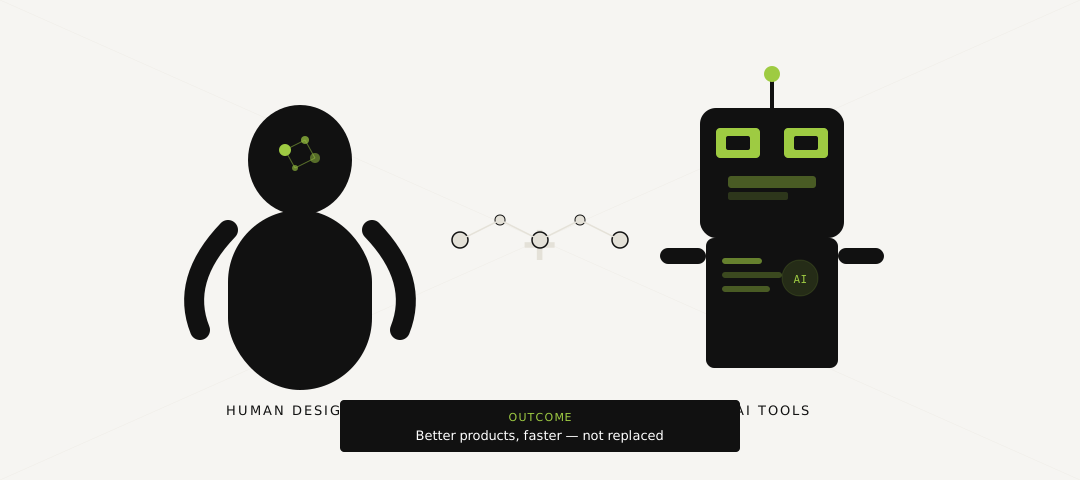
Let me say the quiet part loud: some designers should be worried. Not because AI is coming for design as a discipline — it isn't — but because a significant portion of what passes for design work is work that AI genuinely does better, faster, and cheaper.
If your job is resizing assets, copying components between files, generating social media variants, or producing what is essentially visual decoration with no research behind it — yes, that work is disappearing. Not one day. Now.
But that's not the same as saying designers are being replaced. It's saying that the definition of design is clarifying.
The fear is real but misplaced
The panic around AI and design is rooted in a misunderstanding of what design actually is. Most people — including many people who call themselves designers — conflate the output of design (the screens, the components, the visual artefacts) with design itself.
Design is a problem-solving discipline. The deliverables — the Figma files, the design systems, the prototypes — are evidence of the thinking, not the thinking itself. AI can replicate the deliverables. It cannot replicate the judgment, the research synthesis, the stakeholder alignment, or the empathy that produced them.
"AI can replicate the deliverables. It cannot replicate the judgment, the research, or the empathy that produced them."
What AI has actually changed
Let's be precise about what has changed, because vague fear is useless. AI has genuinely disrupted:
- Execution speed. Generating UI variants, design assets, copy, and basic components now takes minutes instead of hours. The gap between "design decision" and "designed artefact" has collapsed.
- The skill floor. Non-designers can now produce passable UI with AI assistance. The bar for "looks like a product" has dropped to near zero.
- Research synthesis. Analysing user interview transcripts, reviewing competitor products, and clustering themes used to require days. Claude can do a credible first pass in 20 minutes.
- Early-stage prototyping. v0, Claude Code, and similar tools can generate a working interface from a text prompt. The "I need to see it to respond to it" feedback loop has shortened dramatically.
What AI cannot do
Here's the list that matters. AI cannot:
- Define the right problem. AI optimises for the problem it's given. Figuring out whether you're solving the right problem in the first place is a deeply human act.
- Navigate organisational politics. Getting a design shipped requires alignment, negotiation, and sometimes knowing when to compromise and when to hold firm. That's interpersonal intelligence, not intelligence at all.
- Hold nuance across a long research process. User research isn't just data collection — it's developing intuition through extended exposure to how real people experience friction. AI can summarise. It cannot sit in a user interview and feel the weight of something unsaid.
- Make ethical judgments. Who does this design serve? Who does it exclude? What are the second-order consequences? These are value judgments, not optimisation problems.
- Build trust with a client or team. The reason a client says yes to a design direction is partly the work and partly the relationship, the confidence, the track record. AI doesn't have a reputation.
"The designers who will be replaced are not the ones who use AI — they're the ones who refuse to."
The designer's role is evolving, not disappearing
The best analogy I've found is photography and painting. When photography was invented, everyone assumed painting was dead. Instead, painting evolved. Freed from the obligation to document reality accurately, it became more expressive, more conceptual, more itself. The painters who panicked and tried to paint more photographically lost. The ones who leaned into what made painting uniquely painting — thrived.
Design is in the same moment. We're being freed from execution to focus on thinking. The designers who will lead this era are the ones who understand systems deeply, who can frame problems before they can be solved, who can hold the user's experience as a whole rather than just individual screens.
What you should actually worry about
Not whether AI will replace you. Worry about whether you're developing the skills that AI cannot replicate: strategic thinking, research quality, communication, business literacy, ethical judgment. Worry about whether your career is built on craft outputs or on the quality of your thinking.
And on a practical level — worry about whether you know how to use these tools well. Because if another designer can do in 20 minutes what takes you two days, the gap isn't AI versus human. It's human versus human.
Learn the tools. Stay curious. Keep asking the questions that can't be prompted.